






Introduction
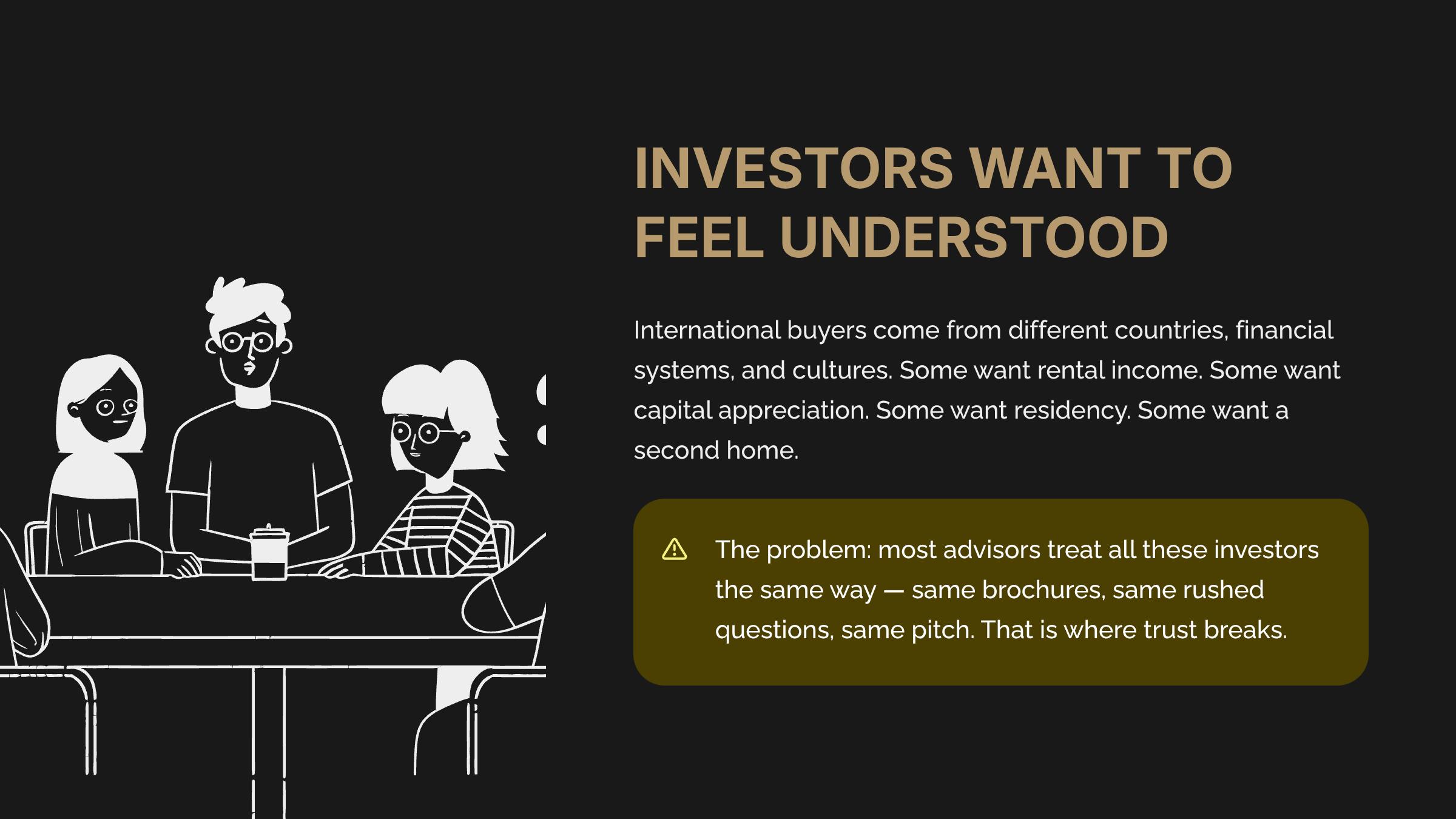
International real estate investors do not want to feel sold to.
They want to feel understood.
This is especially true in markets like Dubai, where buyers often come from different countries, different financial systems, different cultures, and different levels of property investment experience.
Some investors are looking for rental income.
Some are looking for capital appreciation.
Some want a second home.
Some are interested in residency.
Some want to diversify wealth outside their home country.
And some are simply curious because they keep hearing about Dubai’s growth.
The problem is that many real estate professionals treat all these investors the same way.
They send the same brochures.
They ask the same rushed questions.
They push the same projects.
They talk about ROI before understanding the investor’s real reason for buying.
That is where trust starts to break.
The DUBAI Framework was created to solve this problem.
It gives real estate advisors, brokers, sales teams, and property consultants a simple but powerful way to qualify international investors without sounding pushy, desperate, or transactional.
The goal is not to sell harder.
The goal is to advise better.
Because when investors feel properly understood, they are more likely to trust the recommendation that follows.
What Is the DUBAI Framework?
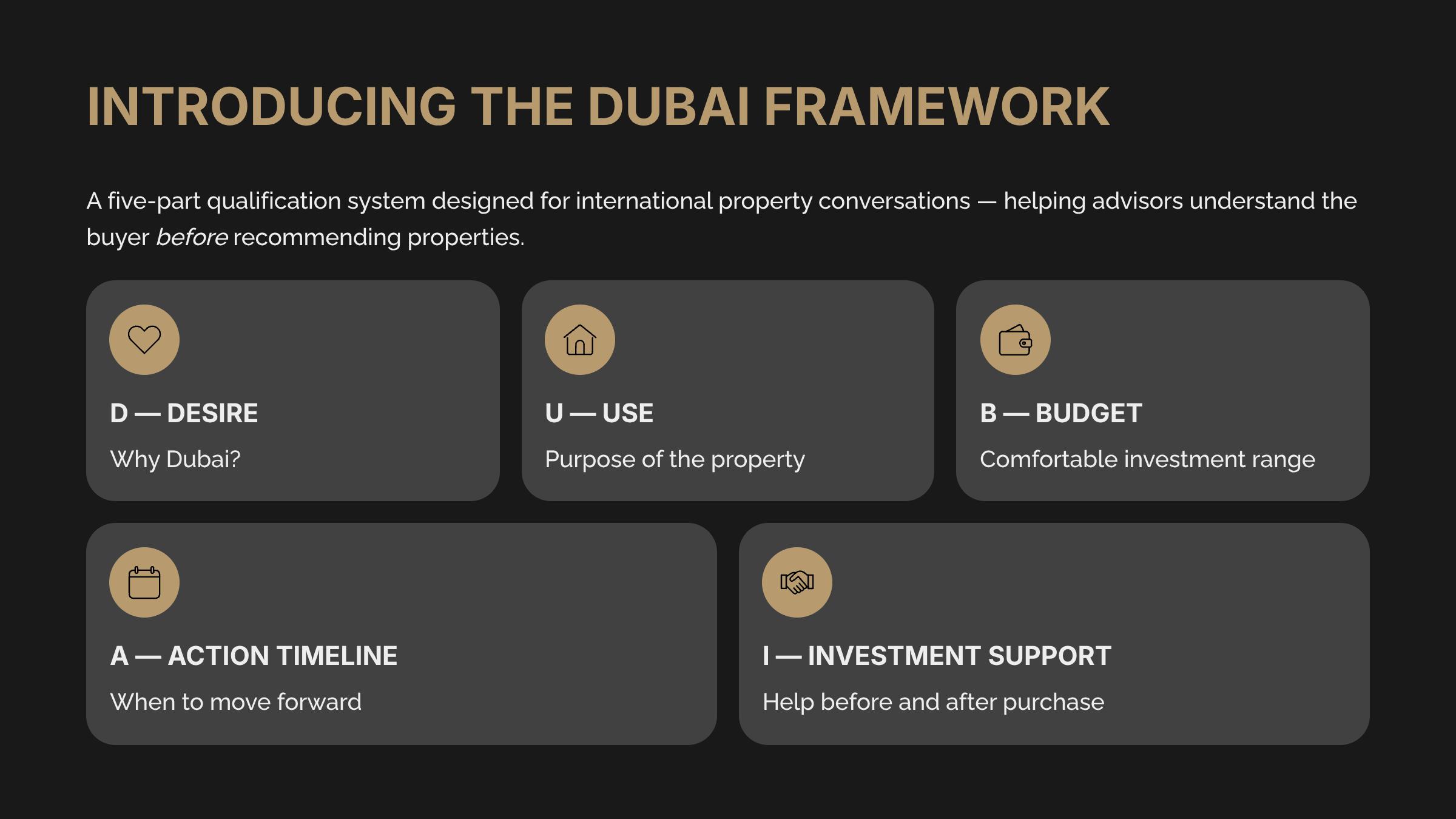
The DUBAI Framework is a real estate investor qualification system designed specifically for international property conversations.
It helps advisors understand the buyer before recommending properties.
The framework is built around five key areas:
D — Desire
Why is the investor interested in Dubai?
U — Use
What is the purpose of the property?
B — Budget
What investment range is comfortable and realistic?
A — Action Timeline
When is the investor looking to move forward?
I — Investment Support
What support will the investor need before and after purchase?
These five areas create a clear qualification flow.
Instead of jumping straight into a property pitch, the advisor starts with the investor’s motivation.
Instead of asking, “What is your budget?” too early, the advisor first understands the buyer’s intent.
Instead of sending random options, the advisor narrows the market based on strategy.
This is what separates a property salesperson from a trusted real estate advisor.
Why Traditional Real Estate Qualification Often Fails
Many real estate agents qualify buyers too aggressively.
They ask questions like:
“What is your budget?”
“Are you ready to buy?”
“Can you pay a deposit?”
“When do you want to purchase?”
These questions are not wrong.
In fact, every serious advisor eventually needs these answers.
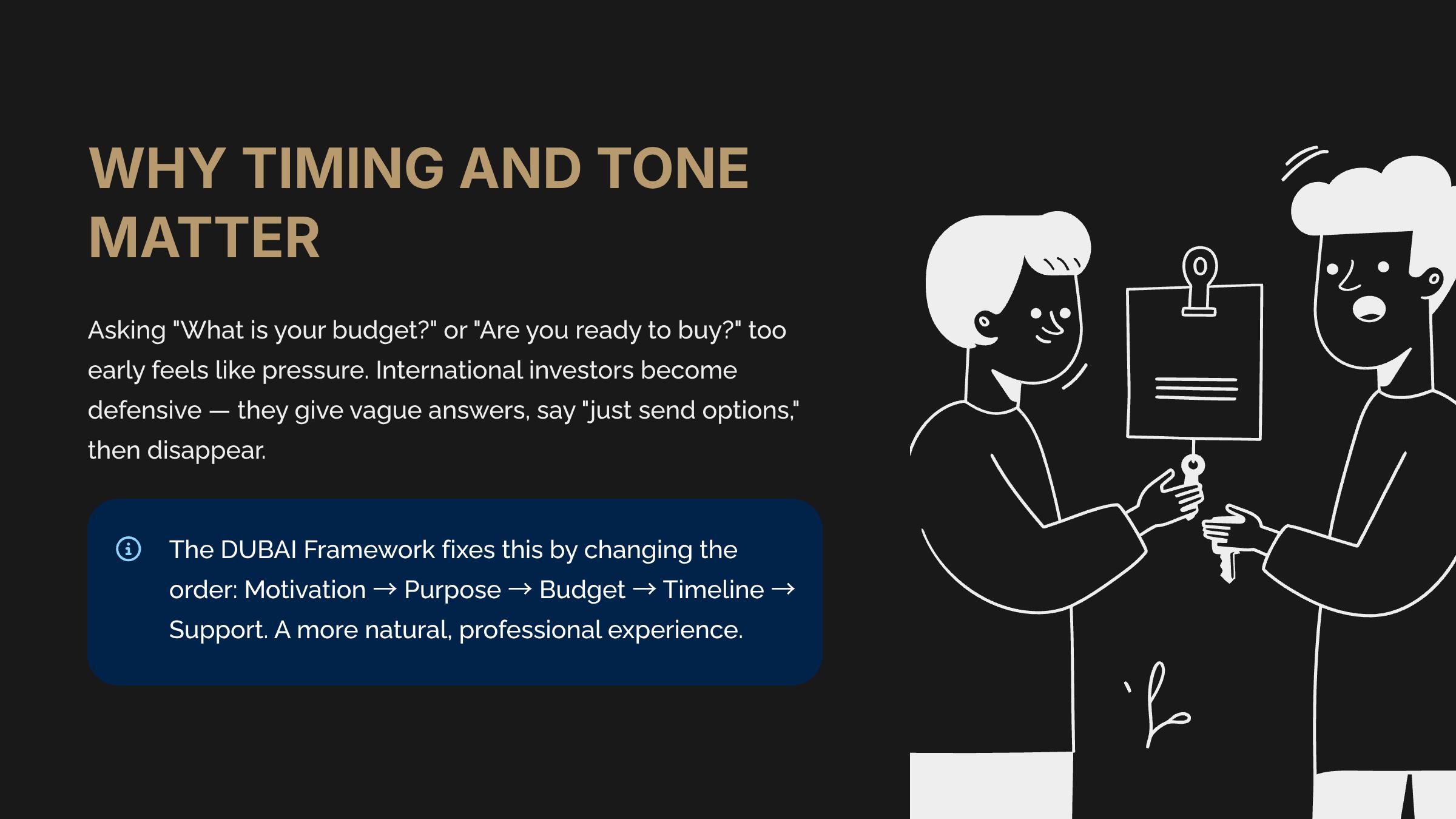
The problem is timing and tone.
When these questions are asked too early, they feel like pressure.
The investor may become defensive.
They may give vague answers.
They may say, “Just send me options.”
They may disappear after receiving a brochure.
This usually happens because the investor does not yet feel understood.
They feel like the advisor is trying to qualify their wallet before understanding their goal.
International investors are especially sensitive to this.
They are often buying in a foreign market.
They may not fully understand the process.
They may have concerns about laws, fees, banking, rental management, developer reputation, or resale.
So before they reveal financial details, they need confidence.
They need to know the advisor is not simply trying to close a deal.
The DUBAI Framework fixes this by changing the order of the conversation.
It starts with motivation.
Then purpose.
Then budget.
Then timeline.
Then support.
This creates a more natural and professional qualification experience.
D — Desire: Why Dubai?
The first part of the DUBAI Framework is Desire.
This means understanding why the investor is interested in Dubai in the first place.
The best opening question is simple:
“What first attracted you to the Dubai property market?”
This question is powerful because it allows the investor to explain their motivation in their own words.
They may say:
“I heard rental returns are strong.”
“I want a holiday home.”
“I am interested in Golden Visa.”
“I want to diversify outside my country.”
“I want to invest in a growing city.”
“I am comparing Dubai with London.”
Each answer tells you something important.
A buyer who wants rental income needs a different conversation from a buyer who wants a lifestyle property.
A buyer who wants Golden Visa needs a different path from a buyer who wants short-term resale.
A buyer comparing Dubai with another global market needs a more strategic conversation.
This is why “Why Dubai?” should usually come before “What is your budget?”
Motivation gives context.
Without context, budget is just a number.
With context, budget becomes part of a strategy.
U — Use: What Is the Purpose of the Property?
The second part of the DUBAI Framework is Use.
This means understanding what the property is actually for.
A useful question is:
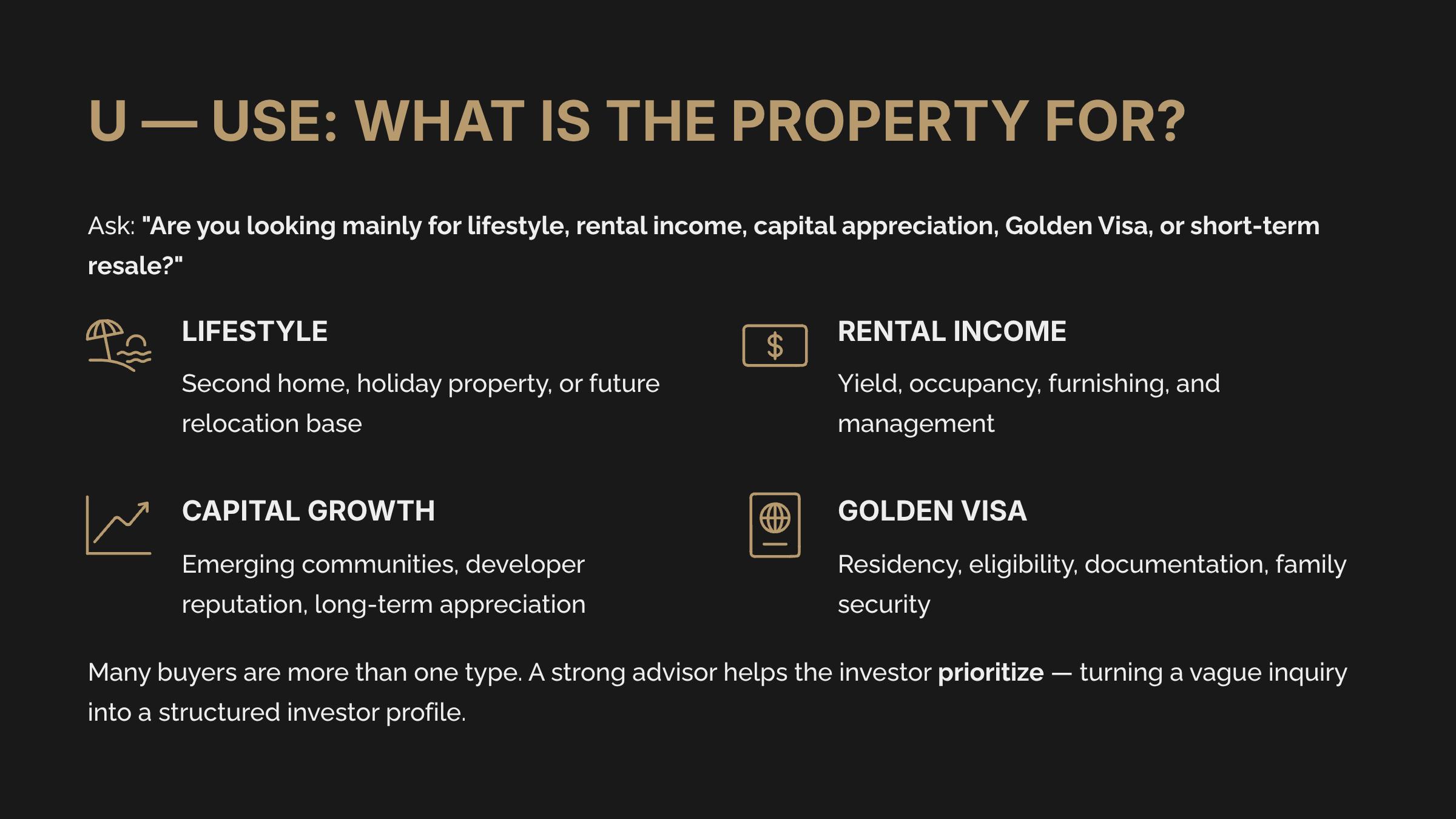
“Are you looking at Dubai mainly for lifestyle, rental income, capital appreciation, Golden Visa, or short-term resale?”
This question helps classify the investor.
Most international real estate buyers fall into one or more of these categories.
A lifestyle buyer may want a second home, a holiday property, or a future relocation base.
A rental investor may care about yield, occupancy, service charges, furnishing, and management.
A capital growth investor may focus on emerging communities, infrastructure, developer reputation, and long-term appreciation.
A Golden Visa buyer may care about residency, eligibility, documentation, and family security.
A buy-and-flip investor may focus on launch pricing, payment plans, resale demand, and exit timing.
A diversification investor may be looking for asset protection, currency diversification, or exposure to a stable international market.
Many buyers are not only one type.
They may want lifestyle and rental income.
They may want Golden Visa and capital appreciation.
They may want rental income now and future relocation later.
The advisor’s role is to identify the primary motivation.
If everything matters equally, the recommendation becomes unclear.
A strong advisor helps the investor prioritize.
This is where the DUBAI Framework becomes especially useful.
It turns a vague property inquiry into a structured investor profile.
B — Budget: What Investment Range Is Comfortable?
The third part of the DUBAI Framework is Budget.
This is where many agents create resistance.
They ask:
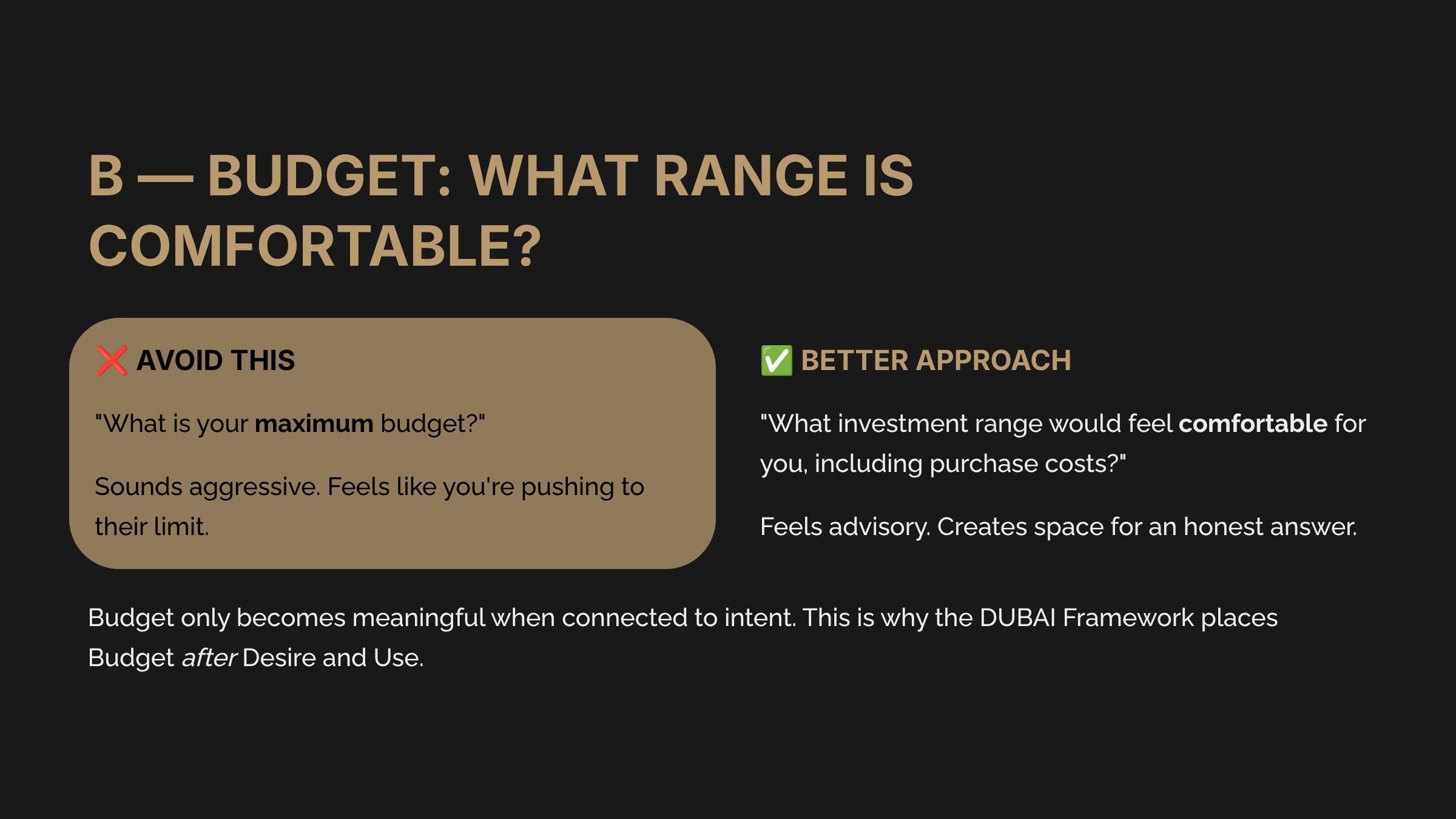
“What is your maximum budget?”
That question may sound logical, but it can feel aggressive.
It may make the investor feel as if the advisor is trying to push them to their limit.
A better question is:
“What investment range would feel comfortable for you, including purchase costs?”
This sounds more professional.
It is not about extracting the highest number.
It is about understanding the right range.
The phrase “comfortable investment range” changes the tone.
It feels advisory.
It also creates space for the investor to answer honestly.
Budget should also be connected to purpose.
If the buyer wants rental income, the budget affects yield, area, property type, furnishing, and management.
If the buyer wants Golden Visa, the budget may need to align with eligibility requirements.
If the buyer wants lifestyle, the budget affects location, view, community, and quality.
If the buyer wants capital growth, the budget affects entry point, area maturity, and holding strategy.
A professional advisor does not treat budget as a standalone number.
Budget only becomes meaningful when connected to intent.
This is why the DUBAI Framework places budget after Desire and Use.
First understand why they are buying.
Then understand what the property is for.
Then discuss investment range.
That sequence feels much more natural.
A — Action Timeline: When Are They Looking to Move Forward?
The fourth part of the DUBAI Framework is Action Timeline.
This is about understanding urgency without creating pressure.
Instead of asking:
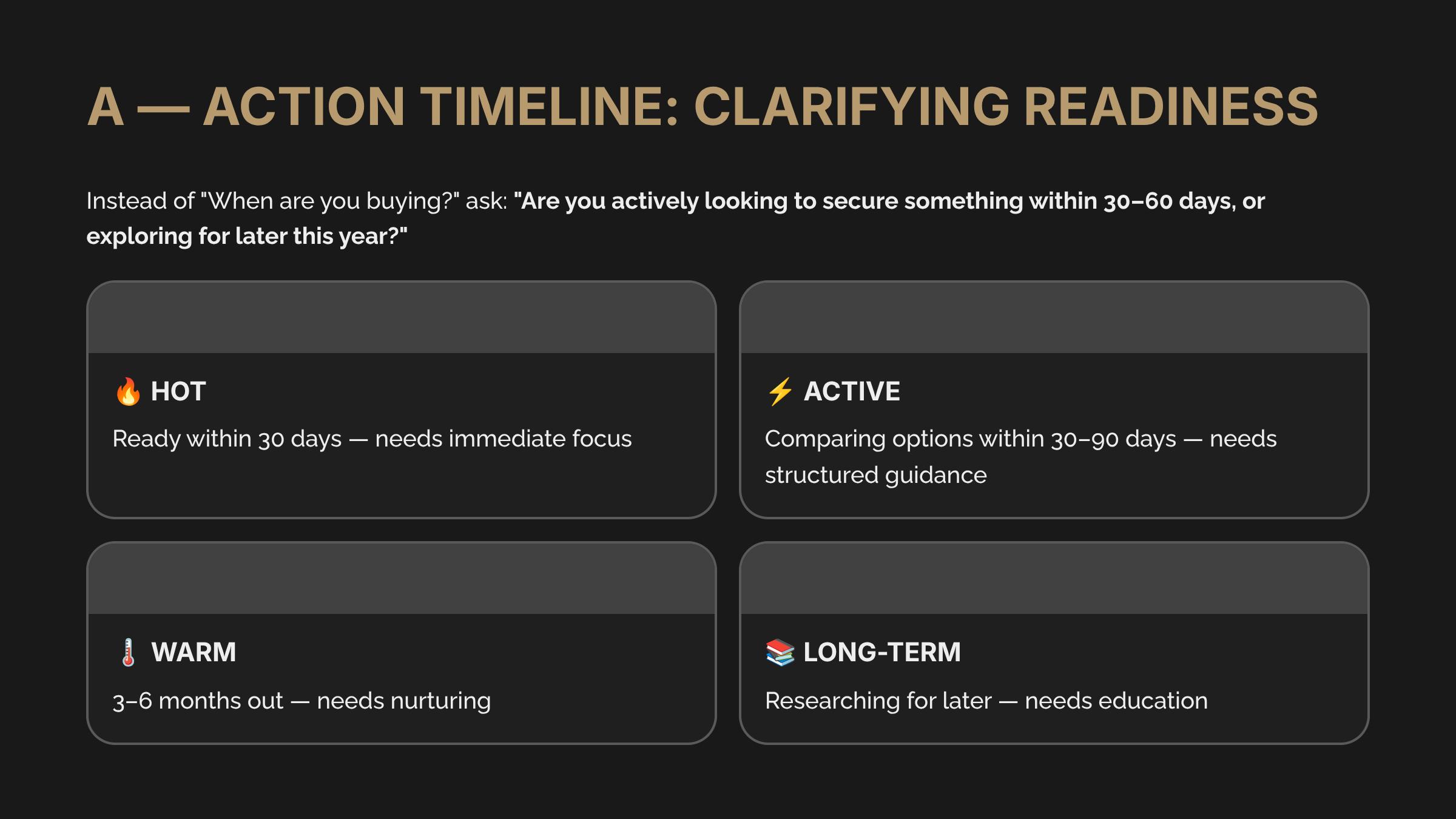
“When are you buying?”
A better question is:
“Are you actively looking to secure something within the next 30 to 60 days, or are you exploring for later this year?”
This gives the investor room to answer honestly.
It does not force them into a yes-or-no response.
It helps you understand where they are in the decision journey.
Some buyers are hot.
They are ready within 30 days.
They have a clear purpose, clear budget, and a realistic payment path.
Some buyers are active.
They may be looking within 30 to 90 days and comparing options.
Some buyers are warm.
They may be interested but not ready for three to six months.
Some buyers are long-term.
They may be researching for later.
Some buyers are unclear.
They have no defined purpose, budget, or timeline yet.
A professional advisor does not treat these buyers the same way.
A hot buyer needs immediate focus.
An active buyer needs structured guidance.
A warm buyer needs nurturing.
A long-term buyer needs education.
An unclear buyer needs deeper discovery.
Action Timeline helps the advisor prioritize follow-up without sounding pushy.
This is not about forcing urgency.
It is about clarifying readiness.
I — Investment Support: What Happens After the Purchase?

The fifth part of the DUBAI Framework is Investment Support.
This is where many agents stop too early.
They focus only on the sale.
But international investors think beyond the purchase.
They ask:
Who will manage the property?
Who will find tenants?
Who will furnish it?
Who will handle handover?
Who will inspect the unit?
Who will advise on Golden Visa?
Who will help if I am not in Dubai?
These are serious questions.
And they matter.
A good qualification question is:
“Would you need support with leasing, furnishing, handover, Golden Visa, or property management?”
This question immediately positions the advisor differently.
It shows that you are not only thinking about the transaction.
You are thinking about the ownership experience.
That is especially important for international buyers.
Many investors are not based in Dubai.
They may need a hands-off investment.
They may need trusted local partners.
They may need introductions to mortgage advisors, property managers, furnishing companies, tax consultants, or visa specialists.
The advisor does not need to be the expert in every field.
But the advisor should understand what support the investor needs and guide them toward the right resources.
This creates long-term trust.
It also creates better client relationships.
The sale becomes part of a bigger advisory journey.
How the DUBAI Framework Changes the Sales Conversation
The DUBAI Framework changes the conversation from pitching to diagnosing.
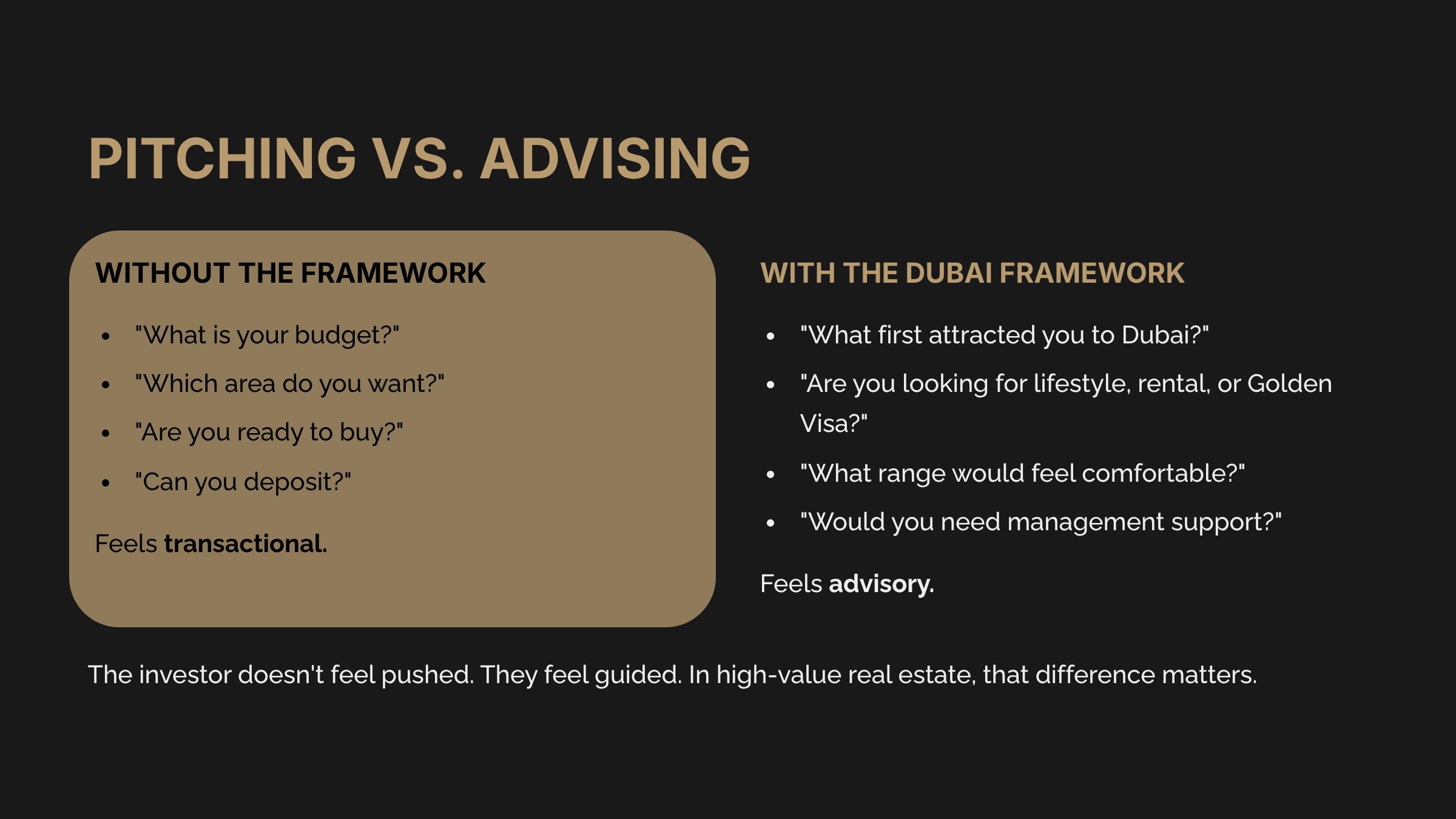
Without the framework, the conversation may sound like this:
“What is your budget?”
“Which area do you want?”
“Are you ready to buy?”
“Can you deposit?”
This feels transactional.
With the DUBAI Framework, the conversation sounds different:
“What first attracted you to Dubai?”
“Are you looking mainly for lifestyle, rental income, capital growth, Golden Visa, or resale?”
“What investment range would feel comfortable, including purchase costs?”
“Are you actively looking to secure something soon, or exploring for later this year?”
“Would you need support with management, leasing, furnishing, handover, or Golden Visa?”
This feels advisory.
The investor does not feel like they are being pushed.
They feel like they are being guided.
That is the real difference.
And in high-value real estate sales, that difference matters.
Why the DUBAI Framework Builds Authority for Real Estate Advisors
Authority is not built by talking more.
Authority is built by asking better questions.
When a real estate advisor uses the DUBAI Framework, the investor experiences a more structured conversation.
They feel that the advisor understands investment purpose, not just property inventory.
They feel that the advisor is filtering the market, not flooding them with options.
They feel that the advisor is thinking about long-term ownership, not only the commission.
This is how trust is created.
A trusted advisor does not simply say:
“I have the best project.”
A trusted advisor says:
“Based on your goal, budget, timeline, and support needs, these are the options that may make the most sense.”
That is a stronger position.
It makes the recommendation feel earned.
It also makes the investor more likely to listen.
For real estate coaches and sales trainers, the DUBAI Framework can also be used to train teams.
It gives new agents a simple structure.
It gives experienced agents a cleaner qualification process.
It gives managers a way to review lead quality.
And it gives brokerages a more professional standard for international investor conversations.
Example of the DUBAI Framework in Action
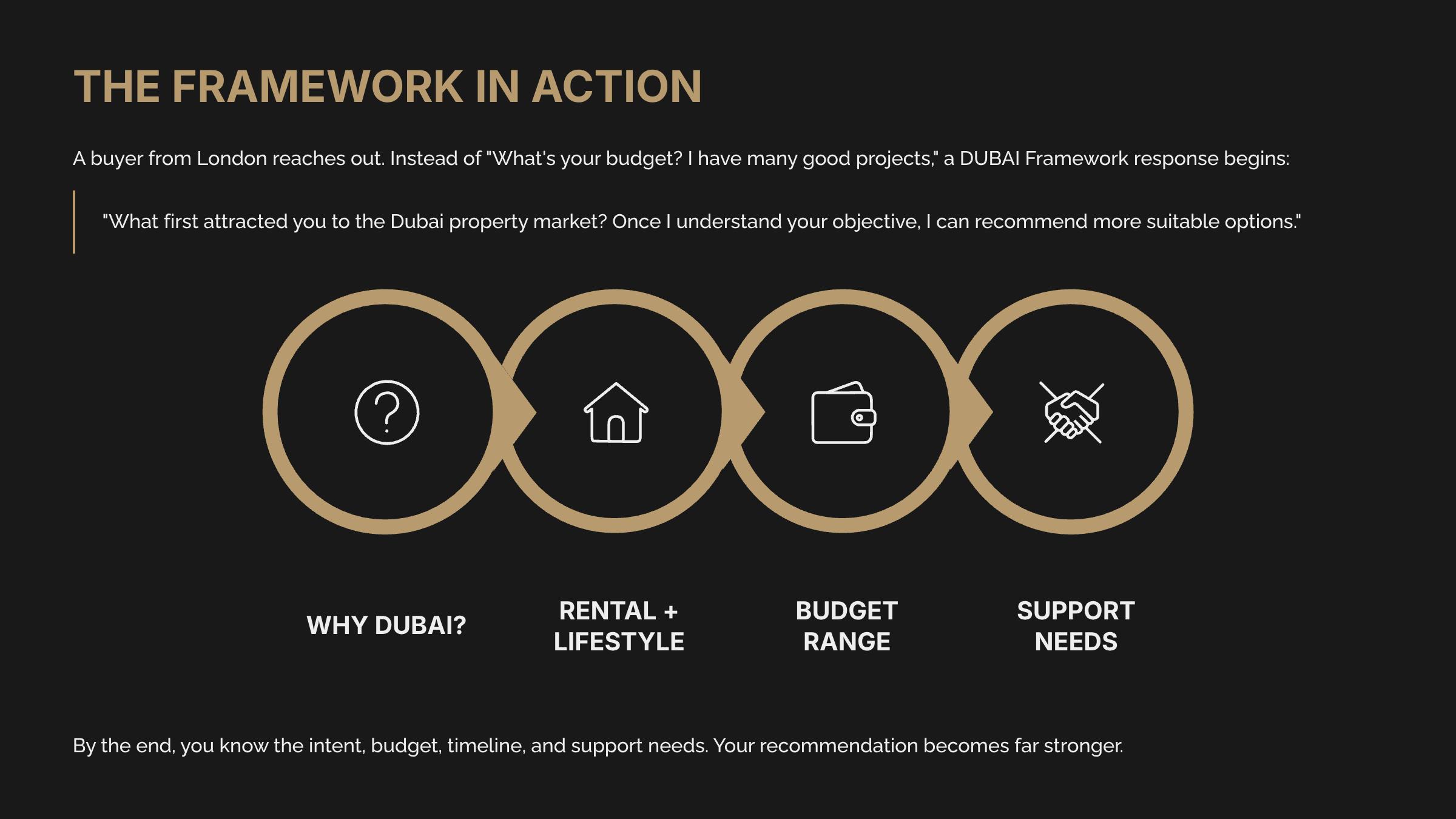
Let’s imagine a buyer from London reaches out about Dubai property.
A typical agent may reply:
“Hello, what is your budget? I have many good projects.”
That may get a response.
But it does not create authority.
Now compare that with a DUBAI Framework response:
“Thank you for reaching out. To guide you properly, may I ask what first attracted you to the Dubai property market? Some investors are focused on rental income, others on lifestyle, capital growth, or Golden Visa. Once I understand your objective, I can recommend more suitable options.”
This immediately changes the tone.
The buyer replies:
“I am mainly interested in rental income, but I may also use the property a few weeks per year.”
Now you know the buyer is rental plus lifestyle.
You can continue:
“That helps. Would you prefer a ready property that can generate income sooner, or are you also open to off-plan if the payment plan and long-term growth potential are strong?”
Now you are guiding.
You are not guessing.
You are not flooding the buyer with projects.
You are building a profile.
Then you ask:
“What investment range would feel comfortable for you, including purchase costs?”
Then:
“Are you actively looking within the next 30 to 60 days, or exploring for later this year?”
Then:
“Since you are based in London, would you need support with furnishing, leasing, or ongoing property management?”
By the end of this conversation, you know who the buyer is.
You understand the intent.
You understand the budget.
You understand the timeline.
You understand the support needs.
Now your recommendation will be much stronger.
The DUBAI Framework Is Not a Script. It Is a Thinking System.
It is important to understand this.
The DUBAI Framework is not meant to make you sound robotic.
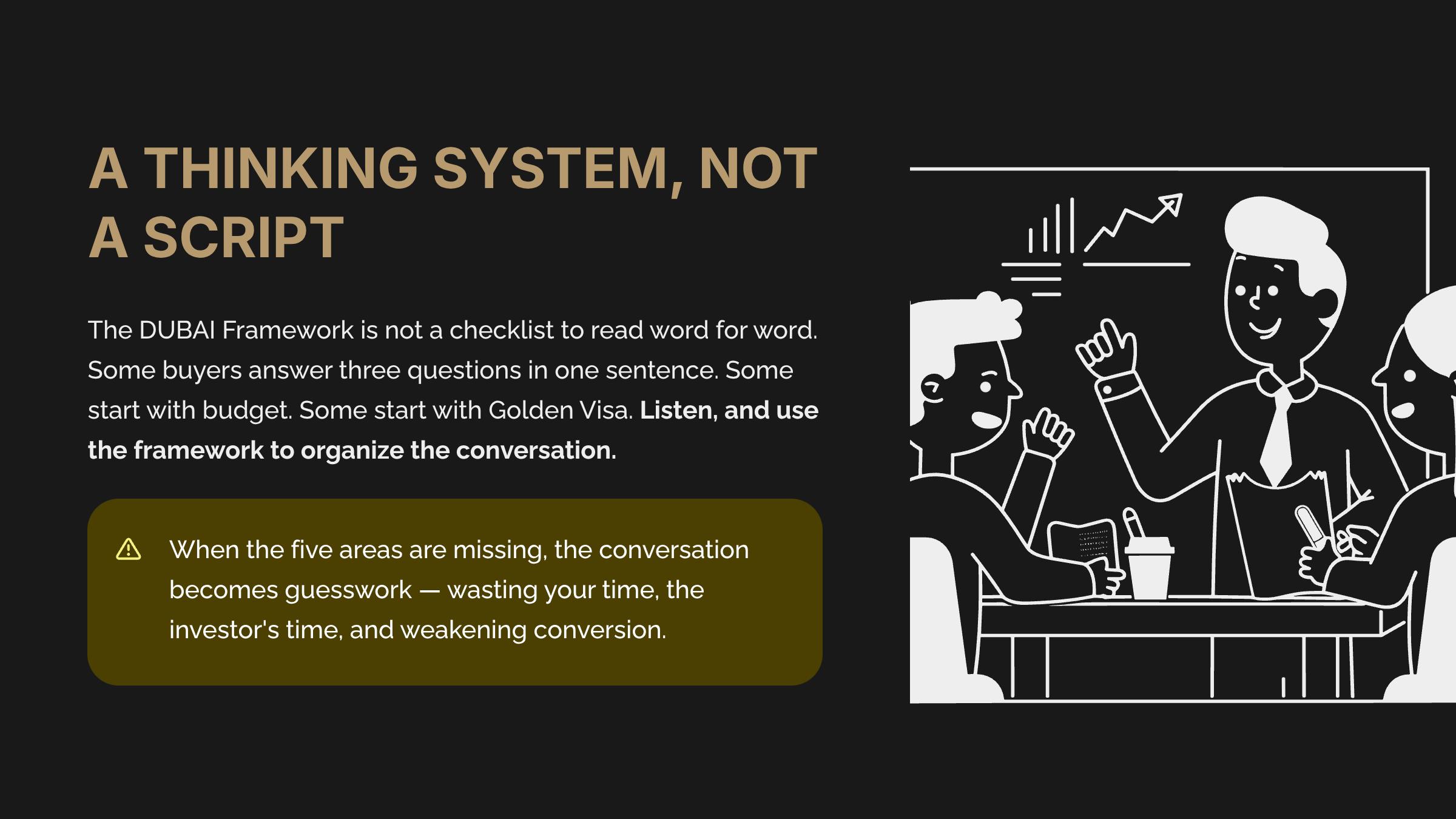
It is not a checklist you read word for word.
It is a thinking system.
It helps you guide the conversation naturally.
Some buyers will answer three questions in one sentence.
Some buyers will need more explanation.
Some buyers will start with budget.
Some will start with area.
Some will start with Golden Visa.
Your job is to listen and use the framework to organize the conversation.
The order may change slightly.
But the core areas should always be covered.
Desire.
Use.
Budget.
Action Timeline.
Investment Support.
When these five areas are clear, the investor is much easier to advise.
When they are missing, the conversation becomes guesswork.
And guesswork is expensive.
It wastes your time.
It wastes the investor’s time.
It reduces trust.
It weakens conversion.
Final Thoughts
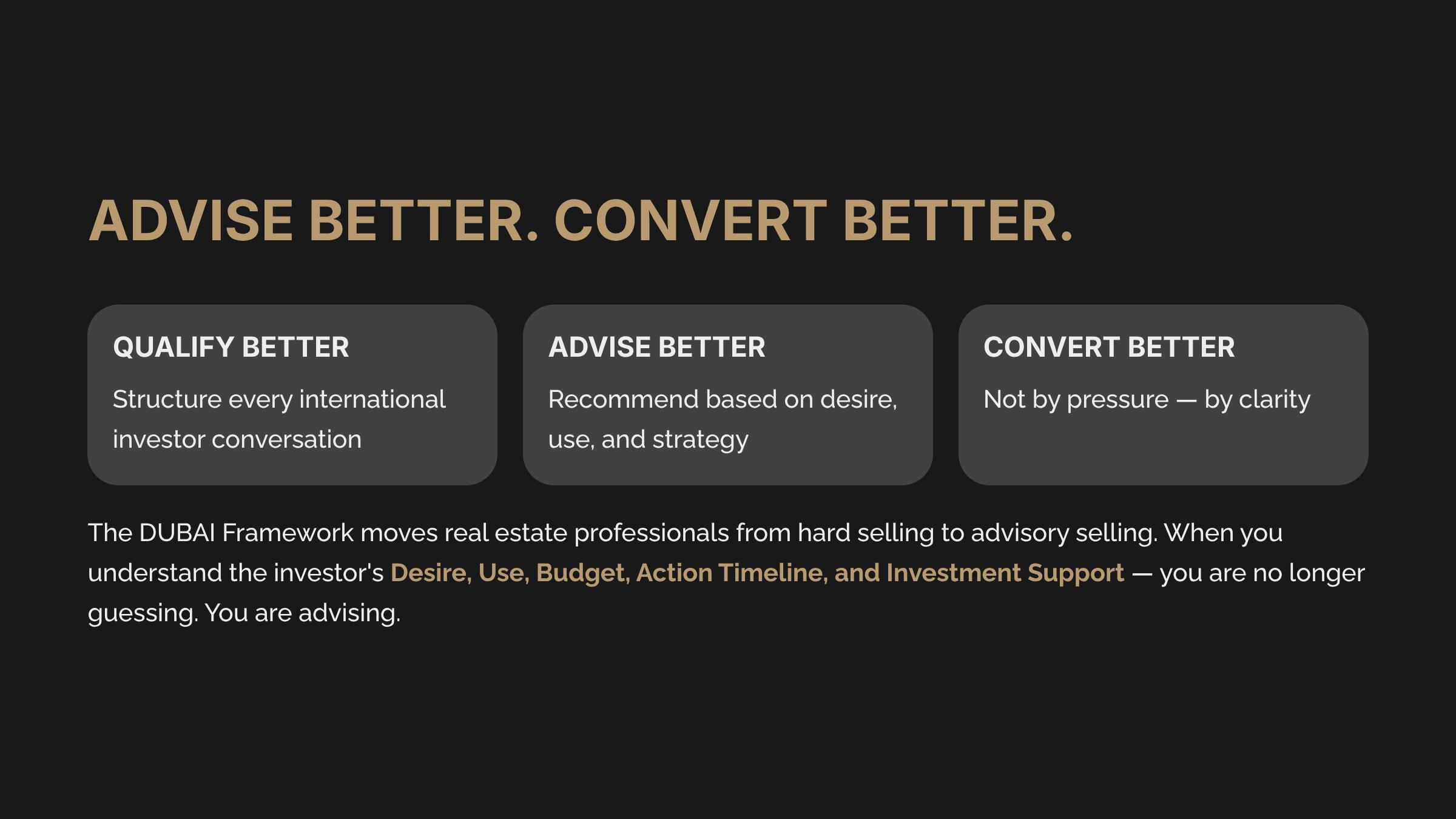
The DUBAI Framework was created to help real estate professionals move away from hard selling and toward advisory selling.
It gives structure to investor qualification.
It helps advisors ask better questions.
It helps investors feel understood.
And it creates a more professional path from inquiry to recommendation.
In international real estate, especially in a market like Dubai, the advisor’s role is not simply to present properties.
The advisor’s role is to create clarity.
When you understand the investor’s desire, use, budget, action timeline, and investment support needs, you are no longer guessing.
You are advising.
And that is the future of high-trust real estate sales.
The DUBAI Framework is simple.
But when used properly, it changes the entire conversation.
It helps you qualify better.
Advise better.
Recommend better.
And ultimately, convert better.
Not by pressure.
By clarity.