





How can Canadian small business owners create a practical growth strategy? Start by choosing one growth path your business can actually deliver and finance, rather than trying to improve everything at once. A useful strategy connects customer demand to capacity, cash flow, people, systems, and measurable action.
Build A Growth Strategy Around A Real Business Constraint
A growth strategy is not a list of marketing ideas. It is a set of choices about where growth should come from, what the business must be able to handle, and how progress will be measured. I recommend treating it as an operating plan, not a document that sits unused after a planning meeting.
A written plan can bring structure to decisions that otherwise feel urgent. FedDev Ontario’s guidance on growing a business explains that a growth plan should address customers, markets, products, distribution channels, and emerging risks, then be revisited as the business grows.
That last point matters. A plan should change when the evidence changes. If a new service attracts attention but produces low margin work, the right response may be to adjust the offer, not to spend more on promotion.
Start With One Clear Growth Outcome
Begin with a 12 month outcome that is specific enough to guide choices. “Grow the business” is too broad. It does not tell you whether to improve retention, increase average order value, enter a nearby market, add capacity, or reduce the owner’s role in delivery.
Choose one primary outcome and two or three supporting measures. For example:
| Primary Outcome | Supporting Measures | What It Reveals |
|---|---|---|
| Increase profitable sales from existing customers | Repeat purchase rate, average order value, contribution margin | Whether customer expansion is adding profitable revenue |
| Add a new customer segment | Qualified leads, sales conversion, acquisition cost | Whether the new segment is commercially viable |
| Expand to another province | Delivery time, regulatory tasks completed, cash tied up in receivables | Whether expansion is operationally ready |
| Reduce owner dependence | Tasks delegated, service quality, turnaround time | Whether the business can grow without creating a bottleneck at the owner |
This is where clarity as a growth advantage becomes practical. Clear priorities make it easier to say no to a tempting product idea, ad campaign, partnership, or technology purchase that does not support the chosen outcome.
Use Customer Research To Find A Credible Opportunity
Customer research should answer a decision question. Do not collect feedback only because it seems like a good practice. Ask questions that help you decide what to build, sell, improve, or stop.
For a service business, speak with recent buyers, repeat buyers, lost prospects, and customers who bought once but did not return. For a retail, wholesale, or product business, review order patterns alongside conversations with customers and sales staff.
Useful questions include:
• What problem were you trying to solve when you looked for this product or service?
• What nearly stopped you from buying?
• What alternative did you consider?
• What would make you buy more often or purchase a broader service?
• What part of the experience felt slow, unclear, or difficult?
Look for patterns, not isolated opinions. If several customers mention delayed quotes, that may be a sales process problem. If customers ask for a related service, that may support an expansion test. If they value speed but your operations cannot deliver quickly, increasing demand first may create dissatisfaction.
Map The Bottleneck Before You Create More Demand
Growth often exposes the narrowest point in a business. More leads do not help if estimates take two weeks. More orders can hurt if inventory arrives late. A full sales pipeline can become a problem if delivery depends on one owner approving every decision.
Before increasing demand, conduct a simple capacity audit across five areas:
• People: Who performs essential work, and who can cover them?
• Process: Which recurring tasks are undocumented, inconsistent, or delayed?
• Equipment and suppliers: What limit prevents additional volume?
• Systems: Where are teams retyping information, losing follow up, or relying on spreadsheets that only one person understands?
• Working capital: Can payroll, inventory, supplier payments, and receivables be funded while sales rise?
This is not a reason to delay growth indefinitely. It is a way to identify the first investment that makes growth safer. The Business Development Bank of Canada notes that Canadian leading SMEs build capacity through workflow documentation and continuous process improvement, using productivity gains and reinvestment to support growth.
Choose The Right Growth Path Before Spending More
Most small businesses have several possible routes to growth. The mistake is treating all routes as equal. Each route has different cash needs, lead times, risk, staffing requirements, and operational consequences.
Compare Growth Options Through A Capacity And Cash Gate
I suggest evaluating every growth idea through two gates before approving it.
Gate one is capacity. Can the business deliver the promise without lowering quality, extending lead times too far, or exhausting the team?
Gate two is cash. Can the business fund the additional inventory, labour, marketing, equipment, and delayed customer payments until cash is collected?
| Growth Route | Choose It When | Avoid Or Delay It When | Main Measure |
|---|---|---|---|
| Sell more to current customers | Customers are satisfied and there is a clear repeat or upgrade need | Retention is weak or service issues remain unresolved | Repeat revenue and contribution margin |
| Acquire new customers | The offer converts reliably and delivery has room | Sales follow up or fulfillment is already strained | Qualified leads and acquisition cost |
| Add a product or service | Research confirms a real unmet need and delivery is feasible | The idea requires major inventory or unfamiliar expertise | Margin by offer and customer adoption |
| Expand geographically | Local demand, logistics, tax, and regulatory needs are understood | Delivery depends on local presence or compliance is unclear | Sales by region and delivery cost |
| Improve productivity | The same bottleneck repeatedly slows sales or delivery | The process is not defined well enough to improve | Cycle time, error rate, and capacity |
Existing customers are often a practical starting point because the relationship and buying context already exist. TD’s small business growth guidance identifies existing customer sales, new customer acquisition, process improvement, and cash controls as practical growth levers for Canadian small businesses.
Still, customer expansion is not automatically the best answer. If repeat customers are leaving because the core experience is inconsistent, a promotion can produce short term sales while hiding a deeper delivery issue.
Track Profitability And Cash, Not Revenue Alone
Revenue is a useful signal, but it does not show whether growth strengthens the business. A growing company can run short of cash when it must pay staff and suppliers before customers pay invoices.
Two measures add needed context:
• Contribution margin: Revenue left after variable costs, such as direct labour, materials, sales commissions, shipping, or payment processing. This indicates how much each additional sale contributes toward fixed costs and profit.
• Cash conversion cycle: The time between paying for inputs and collecting cash from customers. A longer cycle usually increases working capital pressure.
Consider a contractor that wins larger projects. Revenue rises, but material purchases and payroll happen before progress payments arrive. If deposits are too small or invoices are slow to collect, the business can become busier while cash becomes tighter.
Practical controls may include deposits, progress billing, credit limits, inventory reviews, and regular cash flow tracking. The right mix depends on the sector and customer expectations. Fair warning: there is no universal Canadian percentage for a safe growth budget or ideal margin. Your numbers must reflect your own pricing, payment terms, seasonality, and cost structure.
Sequence Geographic Growth Carefully
Expansion beyond your current service area can be attractive, especially when local demand has plateaued. But province to province growth can introduce tax, labour, insurance, licensing, consumer protection, logistics, and service coverage questions. International expansion adds further customs, currency, contract, and export readiness issues.
A practical sequence is usually:
- Test demand in an adjacent or operationally similar Canadian market.
- Confirm delivery costs, lead times, and customer expectations.
- Review provincial tax registration, sector rules, employment obligations, and contract requirements with qualified advisers where needed.
- Build a repeatable delivery process before expanding further.
- Consider export only when the offer, documentation, cash position, and logistics can support it.
The Canadian Chamber of Commerce has noted that Canadian small businesses need financing and operational resources to manage costs, innovate, and reach customers and markets. That is a useful reminder that expansion is not just a sales decision. It is also a resource decision.
Turn The Plan Into A Controlled 90 Day Growth Test
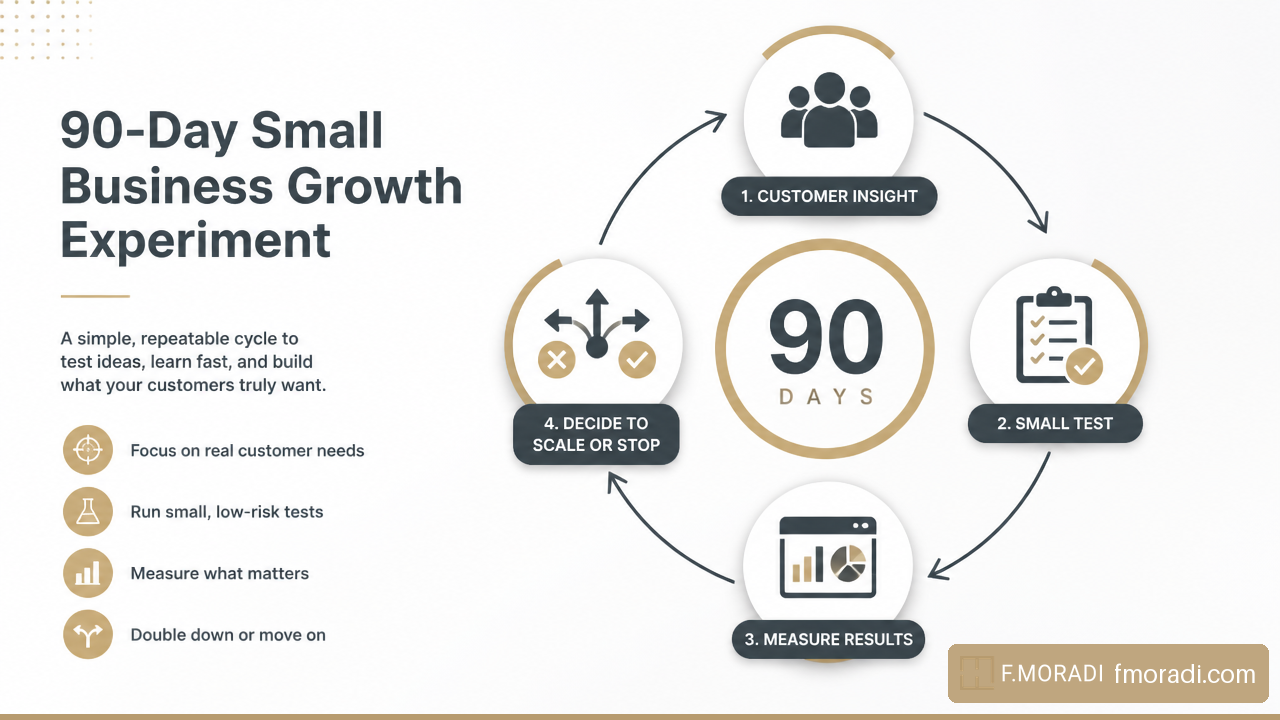
A practical growth strategy becomes credible when it is tested in a limited way. Instead of committing to a large launch, create a 90 day experiment around one growth hypothesis.
For example: If we offer a maintenance package to customers who bought within the past 18 months, we expect to generate enough contribution margin to justify a dedicated follow up process.
The timeframe is not a universal standard. Some sales cycles need longer. Seasonal businesses may need to test during their busiest period. The value of a defined period is that it prevents a vague initiative from continuing without evidence.
Build The Experiment Around One Owner And One Stop Rule
Every experiment needs a named owner. This does not mean that one person performs every task. It means one person is responsible for keeping the work moving, collecting results, and escalating problems.
Your experiment brief should include:
• The target customer and problem being addressed
• The offer and channel being tested
• The baseline performance before the test
• The budget, staff time, and capacity available
• The expected signal of success
• A stop rule that limits avoidable losses
A stop rule might be: pause paid advertising if leads are unqualified after the first review period, halt a pilot service if delivery exceeds the promised turnaround time, or stop accepting work from a new region if shipping and returns erase the expected margin.
This creates discipline. It also prevents teams from defending a project simply because time and money have already been spent.
Separate Acquisition, Retention, And Customer Expansion
Do not combine all sales activity into one “growth” number. You need to know which engine is working.
| Growth Engine | Core Question | Useful Measures |
|---|---|---|
| Customer acquisition | Are we winning suitable new customers? | Qualified leads, conversion rate, acquisition cost |
| Customer retention | Are customers staying and returning? | Repeat purchase rate, churn, time between purchases |
| Customer expansion | Are existing customers buying more value? | Average order value, upgrades, cross sales, revenue per customer |
This separation is especially helpful when a business believes it has a marketing issue. Sometimes demand is sufficient, but follow up is inconsistent, quotes are slow, or sales staff are pursuing poor fit leads. That is why when growth slows it’s rarely a marketing problem is a useful principle: commercial performance depends on the full path from customer interest to delivery and repeat purchase.
Hire, Outsource, Or Automate In The Right Order
Hiring, outsourcing, and technology can all increase capacity. They solve different problems.
Hire when the work is recurring, central to customer value, and expected to remain steady enough to support a role. Outsource when demand is uneven, specialist expertise is needed, or the work is not a core capability. Automate when the task is repetitive, rules are clear, and the process already works reliably.
Do not automate confusion. If staff follow five different steps to create a quote, software may make the inconsistency faster rather than fix it.
A better sequence is:
- Observe and document the current workflow.
- Remove unnecessary approvals, handoffs, and duplicate entry.
- Standardize the best version of the process.
- Train staff and assign clear ownership.
- Add technology where it removes a proven bottleneck.
BDC research on Canadian SMEs describes customer focus, talent, innovation, and investment as connected priorities rather than separate projects. BDC’s analysis of SME growth challenges and winning strategies supports this capability based view of growth.
Key Takeaways
• A practical growth strategy starts with one defined outcome, not a broad ambition to “grow.”
• Test every opportunity against capacity and cash before committing significant resources.
• Use customer interviews, sales data, and lost sale feedback to identify the most credible opportunity.
• Map the operational bottleneck before increasing demand through marketing or new channels.
• Track contribution margin and cash conversion alongside revenue so growth does not create hidden financial strain.
• Run a limited 90 day experiment with one accountable owner, clear measures, and a stop rule.
• Treat hiring, workflow documentation, and technology as dependencies for reliable growth, not afterthoughts.
• Use why founders need strategy filters to evaluate competing opportunities against your chosen direction.
Frequently Asked Questions
What Should A Practical Growth Strategy Include For A Canadian Small Business?
It should include a target outcome, chosen growth path, customer evidence, capacity needs, cash requirements, metrics, responsible owner, timeline, and risk controls. It should also identify what the business will not pursue during the planning period.
How Do I Choose Between New Customers And Existing Customers?
Choose customer expansion when current customers are satisfied, there is a relevant additional offer, and retention is healthy. Choose new customer acquisition when the offer converts well and the business has capacity to serve more people. If customer churn is high, investigate the customer experience before spending heavily on either route.
How Can I Tell Whether My Business Is Ready To Grow?
Review people, processes, equipment, suppliers, systems, and working capital. If one person controls every quote, approval, or customer escalation, growth may increase owner dependence. If delivery quality is stable and the bottleneck is clear, the business is better positioned to grow deliberately.
What Is The Safest Way To Grow Without Running Out Of Cash?
Use cash forecasting that reflects inventory, payroll, supplier terms, customer payment timing, taxes, and debt obligations. Consider deposits or progress payments where appropriate. Test growth in stages so a weak result does not create a large inventory or hiring commitment.
How Much Should A Small Business Budget For Growth?
There is no reliable universal percentage. Set a budget based on expected contribution margin, cash timing, available working capital, and the amount you can afford to lose if the test fails. For example, a business with slow paying commercial customers may need a smaller marketing test than a business paid at the point of sale.
What Should I Do If Sales Rise But Profit And Cash Fall?
Check pricing, direct labour, materials, discounts, delivery costs, payment terms, and receivables. Separate profitable sales from low margin sales. You may need to change the customer mix, tighten credit controls, adjust deposits, raise prices, or pause an offer that consumes too much working capital.
Sources And References
• Business Development Bank of Canada — Strategies Used by Canada’s Leading SMEs: https://www.bdc.ca/globalassets/digizuite/17270-strategies-used-by-canada-leading-sme-study.pdf
• FedDev Ontario — Growing Your Business: https://sbs-spe.feddevontario.canada.ca/growing-your-business
• BDC — SMEs & Growth: Challenges and Winning Strategies: https://publications.gc.ca/collections/collection_2017/bdc/Iu134-1-2-2015-eng.pdf
• TD Canada Trust — Four Strategies to Grow Your Existing Business: https://www.td.com/ca/en/business-banking/small-business/learn/growing-your-business/business-growth-strategies
• Canadian Chamber of Commerce — A Portrait of Small Business in Canada: Adaptation, Agility, All at Once: https://chamber.ca/news/a-portrait-of-small-business-in-canada-adaption-agility-all-at-once/